

What we’re breaking down: The anatomy of a private equity deal
Why it matters: Knowing the specifics of a deal help you navigate the process from buyout to earnout
Read time: The time it takes to water taxi anywhere (8 minutes for real though)
If you are just tuning in, today we are continuing our series on private equity. Specially talking about the anatomy of a deal. For today’s episode I am going to use a wholly owned fictional subsidiary of my brain for illustrative purposes. Any likeness to practices living or deceased are entirely coincidental. Names have been changed to protect the innocent.
But first, if you haven’t, I 7 out of 10 recommend you go back and read Part I: The Sponsor-to-Sponsor Machine.
And so you can keep track and know where you are, here’s a friendly map of sorts:
Part 1: The Sponsor-to-Sponsor machine
Part 2: The anatomy of a deal (tiny red dot, oversized arrow, you are here)
Part 3: When the mechanics fail and the machine breaks
Part 4: When it all comes together and the machine makes a Wonka bar
Please meet our practice being acquired: Dr. Kneesandhips Emporium Limited. We’re diving right into numbers, so stay with me. If you get lost, scroll back to the map, or alternate ending, put your phone down and just grab a mimosa.
Now, this is a practice example, since most of y’all are all up in healthcare practices and hospitals. But the elements hold true for other private equity deals too. I just like talking medical practices. And we work with them. Well, you.
Back to business.
Here is the set-up:
Ortho practice – you met it already, it’s called Dr. Kneesandhips Emporium Limited. I say that only because I really want you to know how funny I think I am. 8 docs – all partners. They just got a sweet offer from Esquire Pennyworth the XIX.
Here is the simplest P&L you have ever seen:
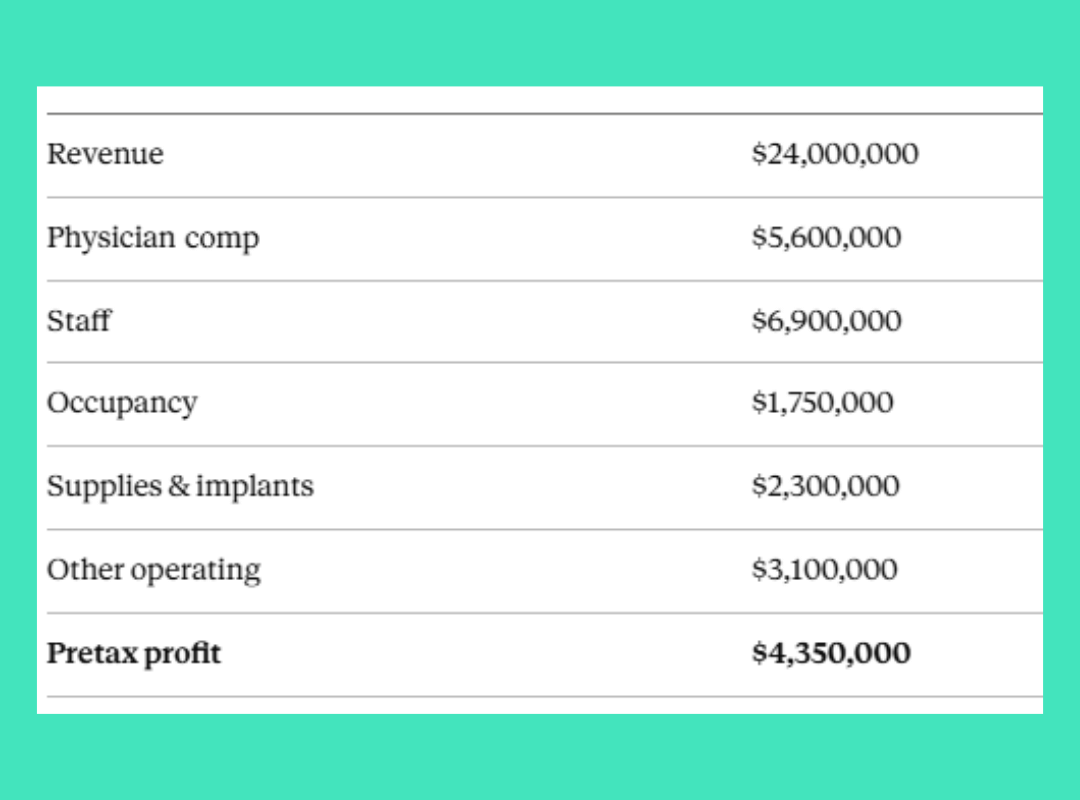
Not too shabby at all. What you don’t see on the P&L is what is happening behind the scenes over on the cash flow statement and on the balance sheet.
Distributions.
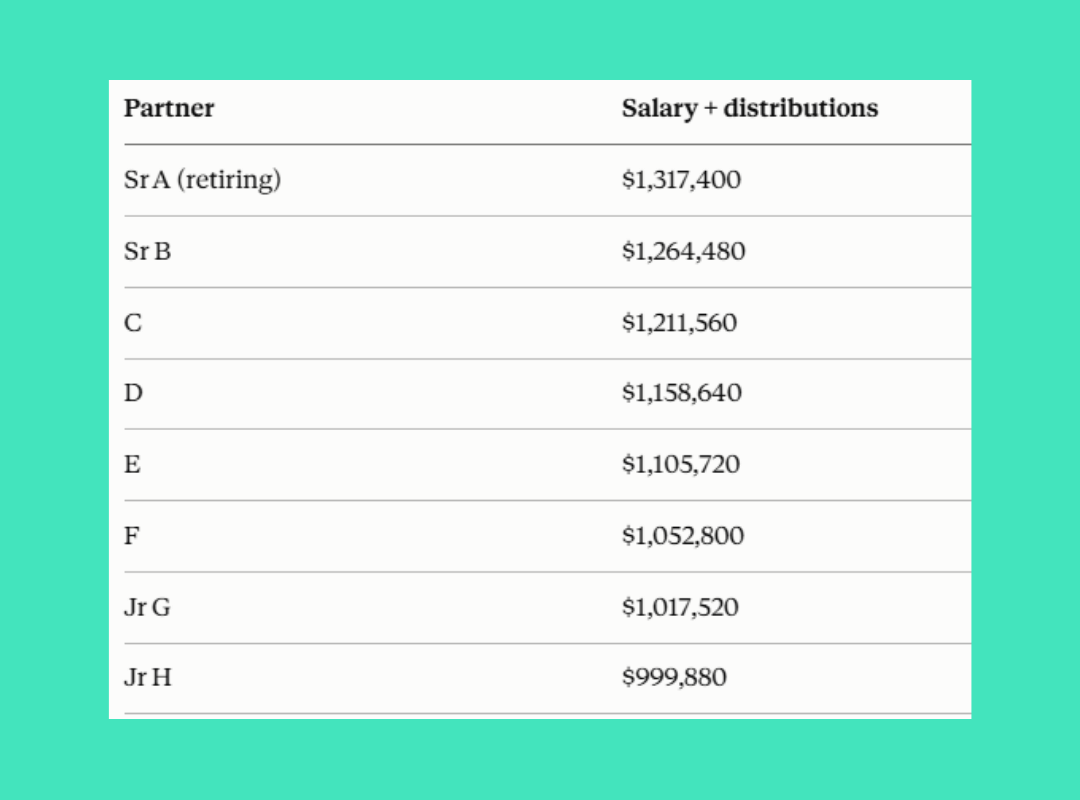
Partners take distributions from the practice. In total, in this fictional scenario the partners are making about $700K in salary and then split a portion of the pre-tax earnings as distributions.
It’s a portion because they need to do things like pay taxes, maintain the capital equipment through maintenance capex, and likely keep some cash around in case a squirrel gets in the attic. Those things can get out of hand fast.
This part seems as random as a squirrel in the attic, but we are going to come back to these numbers.
In this case let’s say the partners distribute about $3.5M. Here’s a chart of comp plus distributions:
All right now that’s all the set up. Here’s how the deal goes down.
Pennyworth says, “I would like to buy your practice. It will go oh so nicely on my mantel next to the Renoir.”
You say, one moment please we will prepare our earnings report and you can base your multiple off of that.
Ok, you don’t actually say that and I am not even sure what a Renoir is, but the point here is that the practice is going to put information together to show to the buyer. As part of that, the practice, their banker, accountant, and best friend who made his money in sweater vests, are going to make adjustments to the earnings.
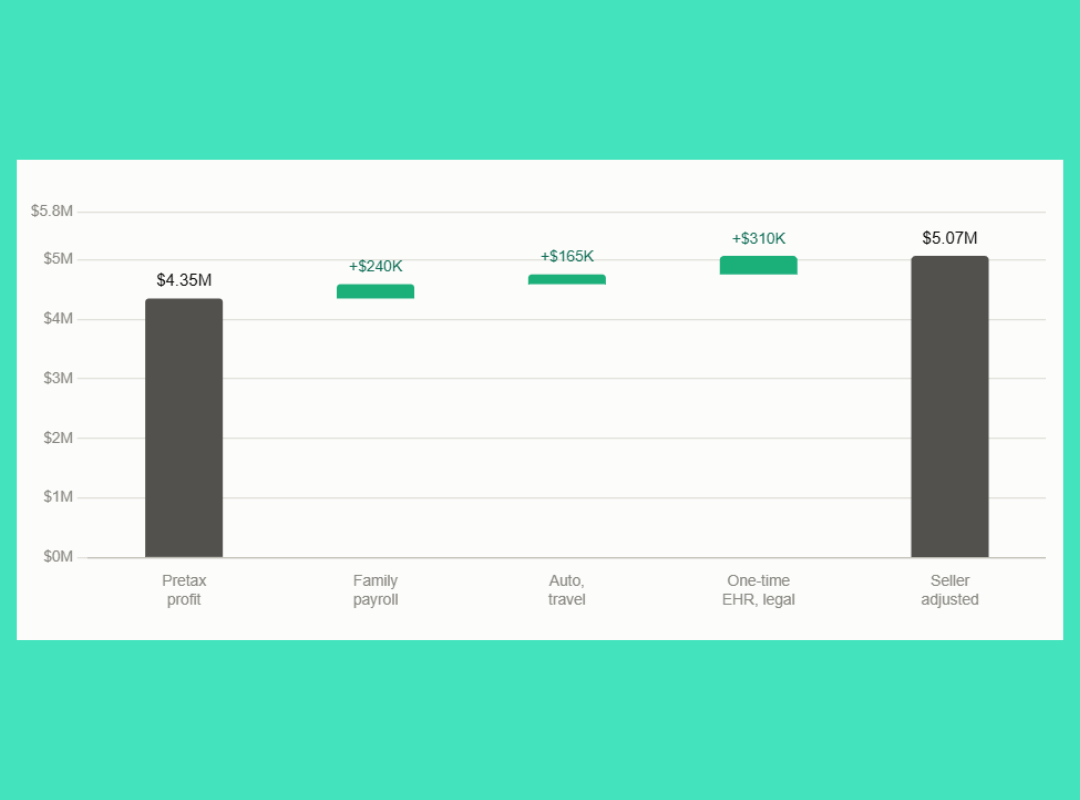
Basically, they are saying here is a bunch of stuff that we pay ourselves too much for and we are going to add that back into EBITDA. The proverbial and oh so coveted Adjusted EBITDA.
For Dr. Kneesandhips it looks something like this gorgeous waterfall chart that I made entirely on my own with no robotic help whatsoever.
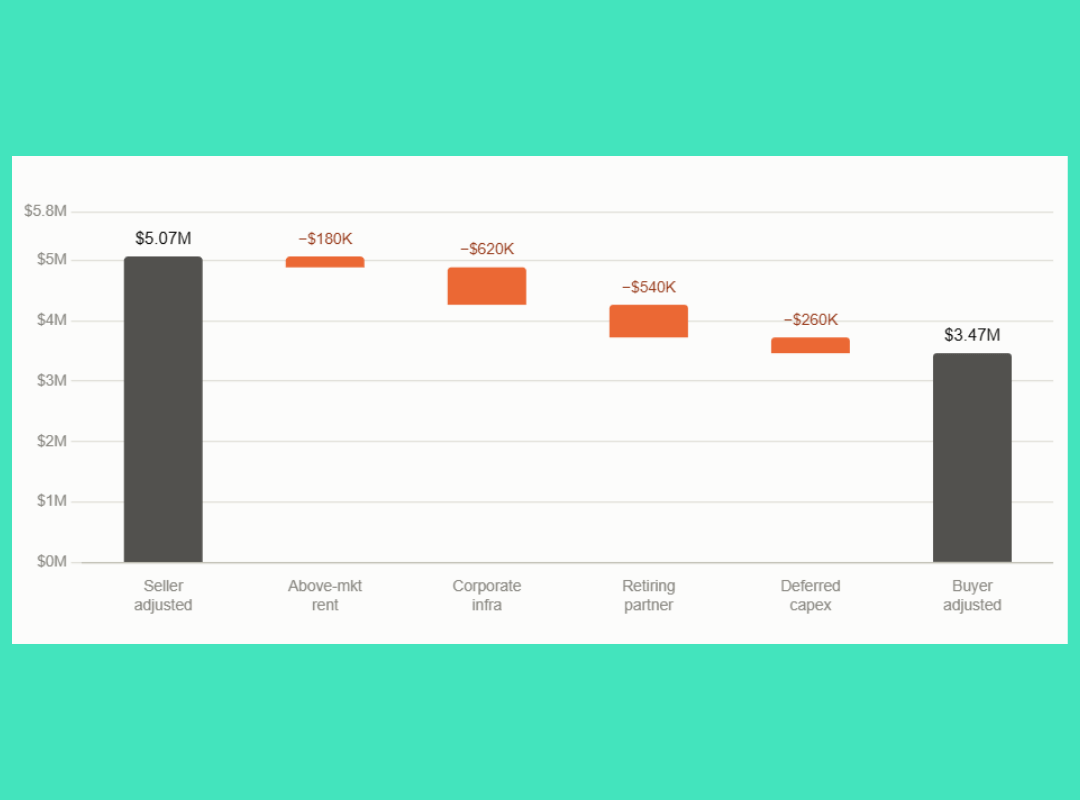
Sire Pennyloafer thanks you with a courtesy and then unleashes a fleet of recently graduated MBAs to reconcile the practice’s adjustments based on what they found during due diligence. In this case, they agree with the practice’s initial adjustments but have more to apply.
Here is their finely crafted, definitely not AI-ified waterfall:
Here’s the table side by side:
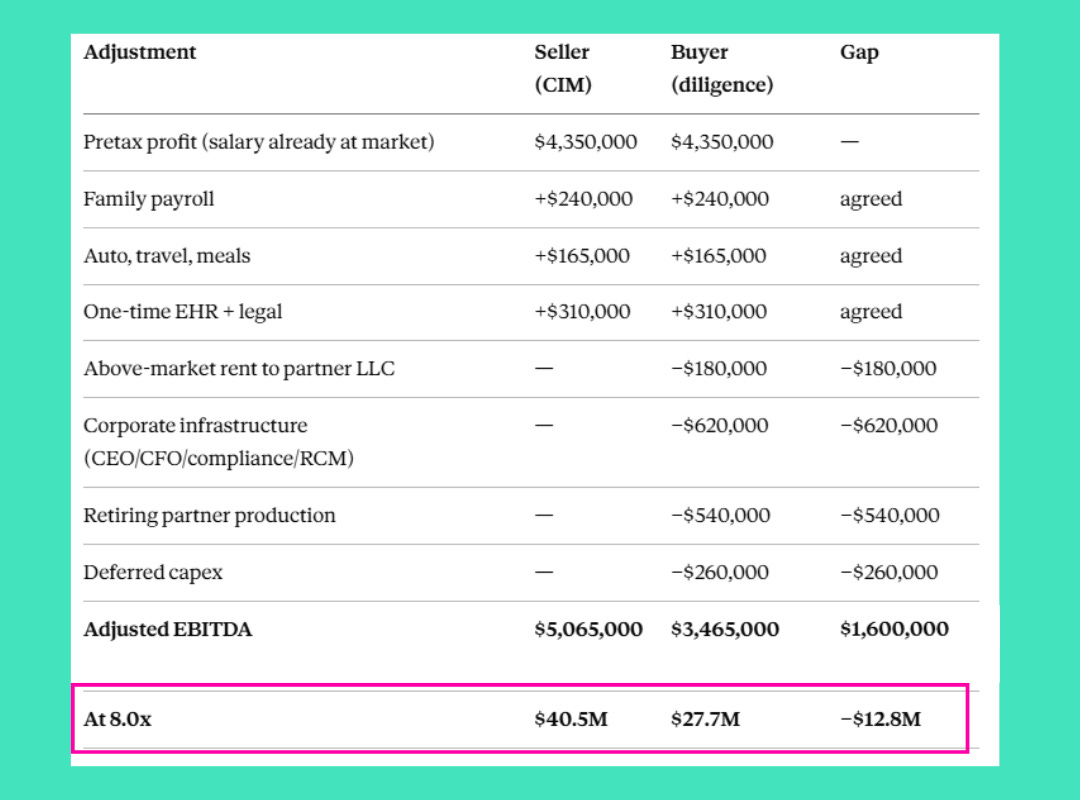
The punchline here is that the gap between the two EBITDA numbers is a negative $12.8M impact to the valuation. Now, adjustment reconciliation is not always so clean and there can be some horse trading, but let’s just say the practice says, okidoke and keeps rolling.
Now the offer is on the table. 8x EBITDA puts the Valuation at $27.7M.
Shaaaaawweeeeet. It’s like beach weather in February. Christmas come early. Everyone is happier than a pig in, well the stuff that pigs are happy in.
But wait! There’s this whole really big long contract that comes along with the offer. And in it a host of financial terms, elements, provisions, clauses, all the good stuff.
I am just going to jump to the punchline and then go through the elements. Naturally, here’s another hand drawn waterfall showing the offer and the cash that actually gets paid at close:
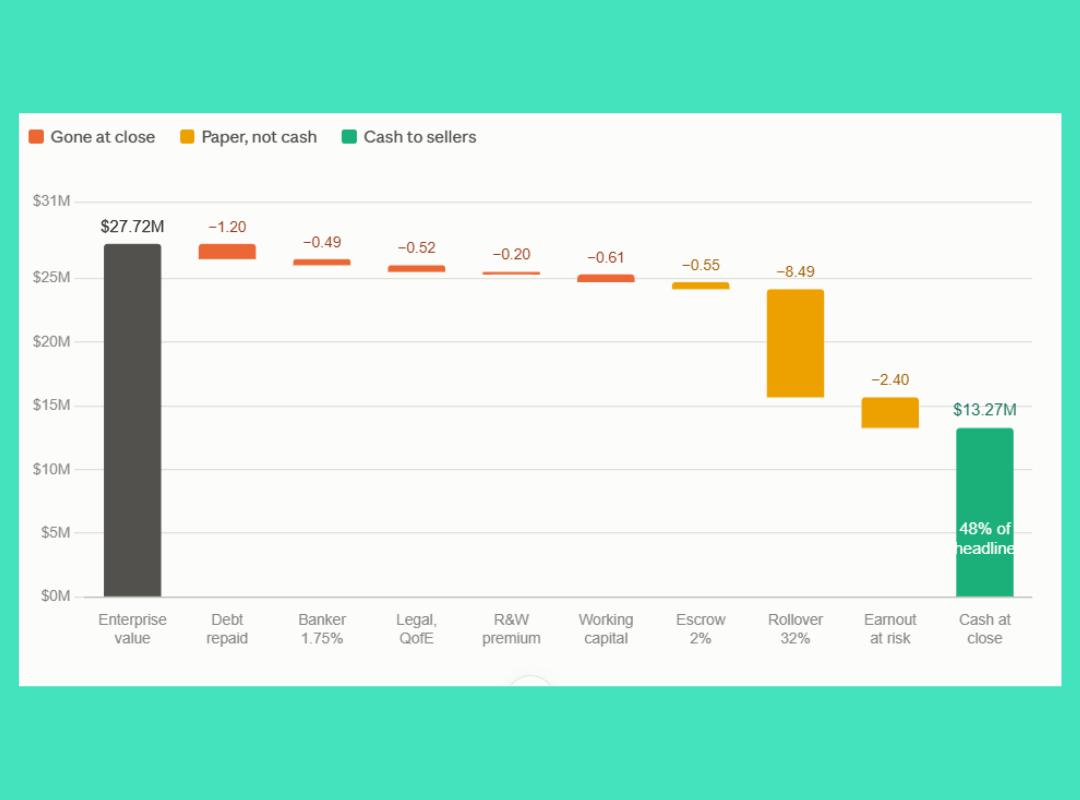
Yes, the $27.7M deal pays out $13.3M today. Paid out to 8 partners on a pro rata basis (which is a fancy way of saying your cut is based on your ownership percentage).
Because I am in a charty mood, here’s two ways to look at the payout:
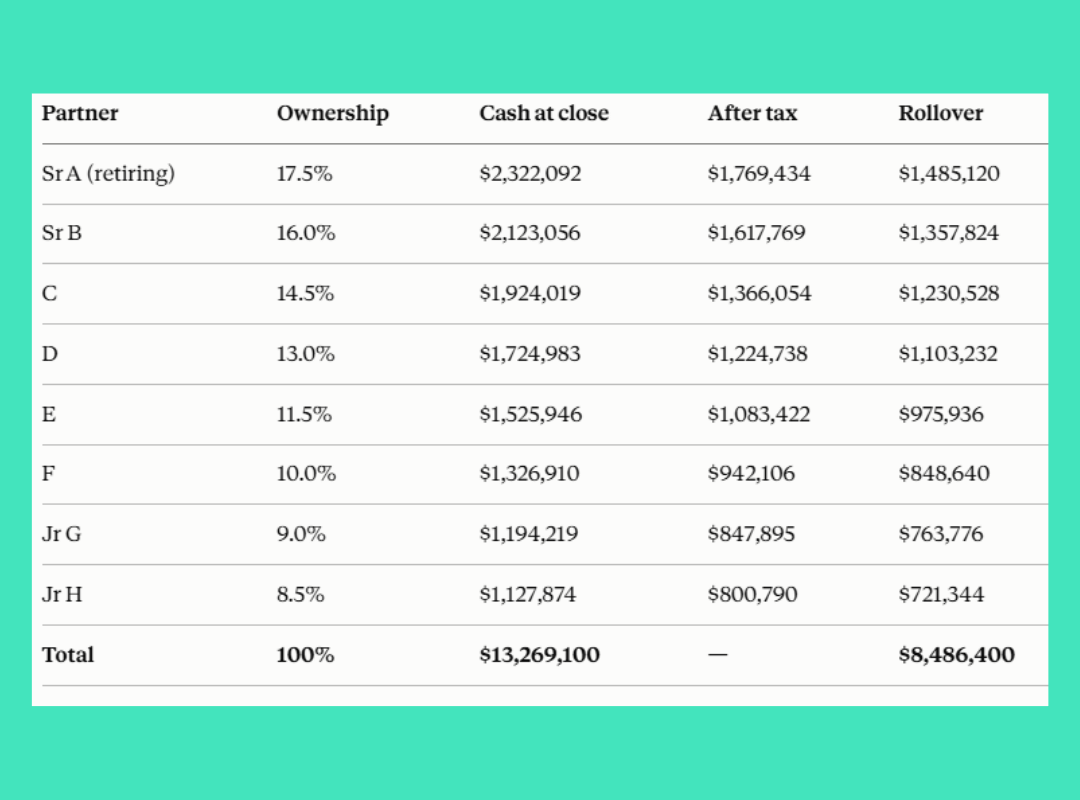
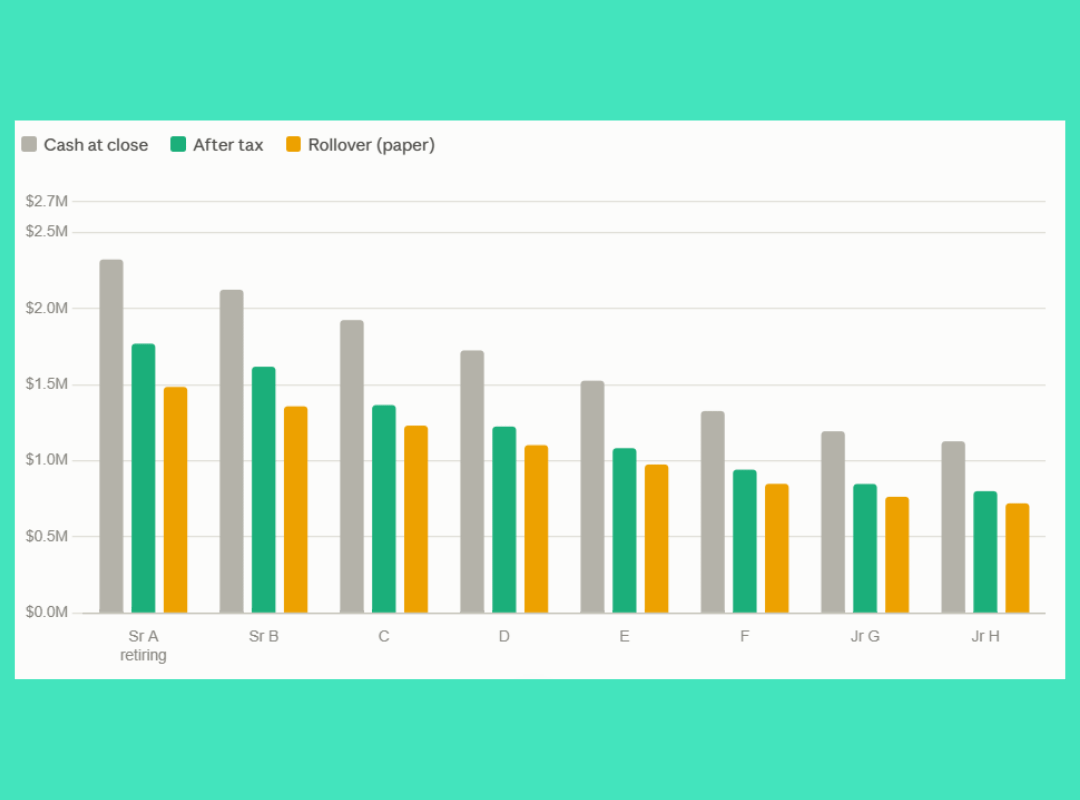
You can see that the payout cascades from senior partner to junior partner. It makes sense as the junior partner owns less and has a longer career pathway to continue earning. There is one more chart and then we are going to go back up to the waterfall and talk about how that $27.7M became $13.3M.
This one:
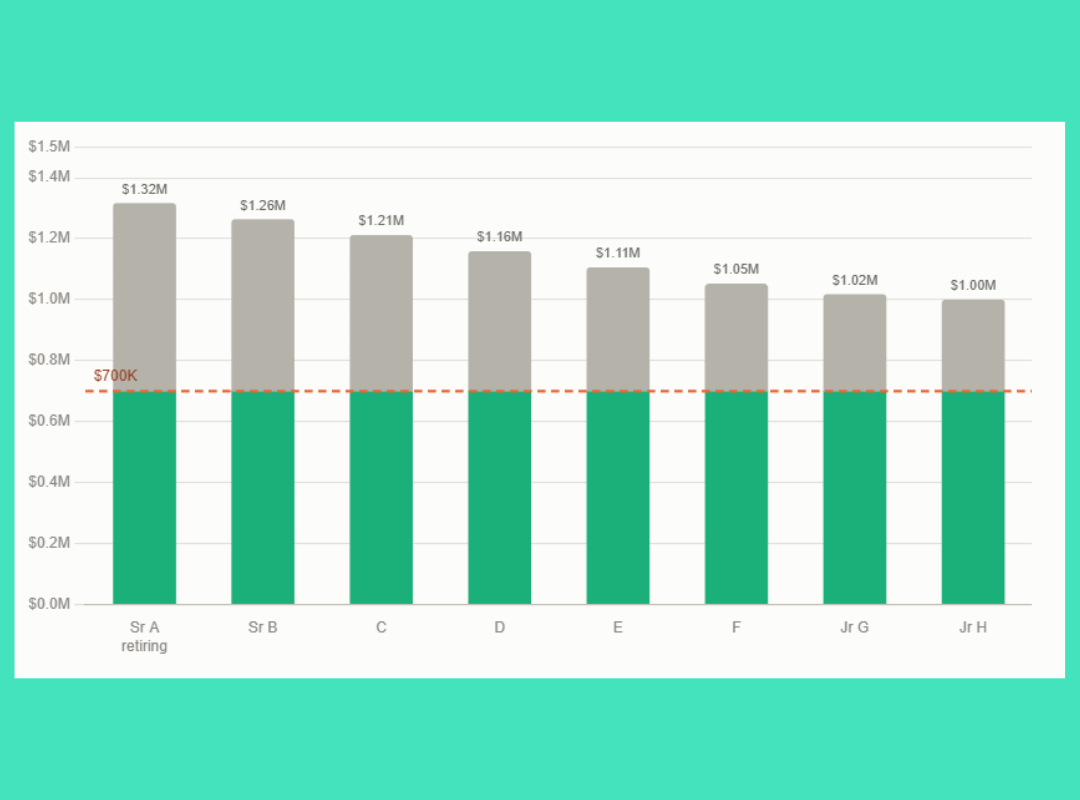
After the deal goes through, the partners don’t own the practice anymore. As a result, they don’t get distributions. Total comp for everyone drops to the baseline of $700K with varying levels of total impact to compensation.
What’s happening in the simplest of terms is that the partners are forgoing future earning for a payout today. They are also placing a bet on the fabled second bite of the apple, which brings us back to the waterfall showing the cash at close falling to $13.3M.
4 things on here are plain to see. You have to pay Pennyloafer’s banker cousin. Legal is always going to run the billable hour glass as long as they can. Escrow is a word.
The ones I want to go a little deeper into are Debt Repayments, Working Capital, Earnout Risk, and Rollover.
Debt repayments is the buyer inheriting none of the practice’s debts. It takes repayments out of the offer. In this case, the practice carries $1.2M in debt, which is paid out of the proceeds of the sale.
Next is working capital. This one can be sneaky. The buyer expects to be able to run the business day one. That means it needs a certain amount of working capital in the business to do so. Someone has to pay for Dr. Hamstring’s fountain pens, which are definitely a reasonable office expense. If the working capital at close is lower than a previously agreed-to amount, that money comes out of the seller’s cash faster than a Good Burger gets served up.
Earnout risk is a buyer’s move to protect itself against people leaving or swings in the business. It’s usually a profit target that if not reached, the buyer keeps it.
And last but not least, the rollover equity. Private equity likes to talk about eating apples more than a garden of Eden reenactment troop. When you hear, “second bite of the apple,” it’s about the rolled equity.
They give the partners in this case about $8.5M in equity in the new company, or NewCo if you want to be cooler than that guy who still wears v-necks and beanies in summer. And while it does take “cash” from the deal and locks it up until the company is sold again, it does represent potential upside for a larger transaction later. For example, if all goes well in private equity land, they end up being cool, buy more practices and end up with a sales that commands a 10x multiple on a much higher EBITDA amount, that may become meaningful money.
But before we wind down this mechanical journey I want to emphasize the last part with another important piece I flippantly mentioned earlier.
For the junior partners and really any partner or owner selling – you are selling the potential for future earnings. The deal is a trade. You get money now by selling them the future of the business.
Sometimes you win. Sometimes you lose.
You can see it here, that the partners are selling their future earnings – the distributions primarily – for the cash and rollover equity now. If we look at our example on a 7 year time horizon, forgoing distributions in favor of cash and rollover equity, the outcome is dependent on deals that are out of the partners’ hands.
In both scenarios, if (and that can be a big if) there is a secondary platform sale, everyone makes more than if they had held on to the practice. It does also assume steady state in the practice with no growth. But you catch my drift.
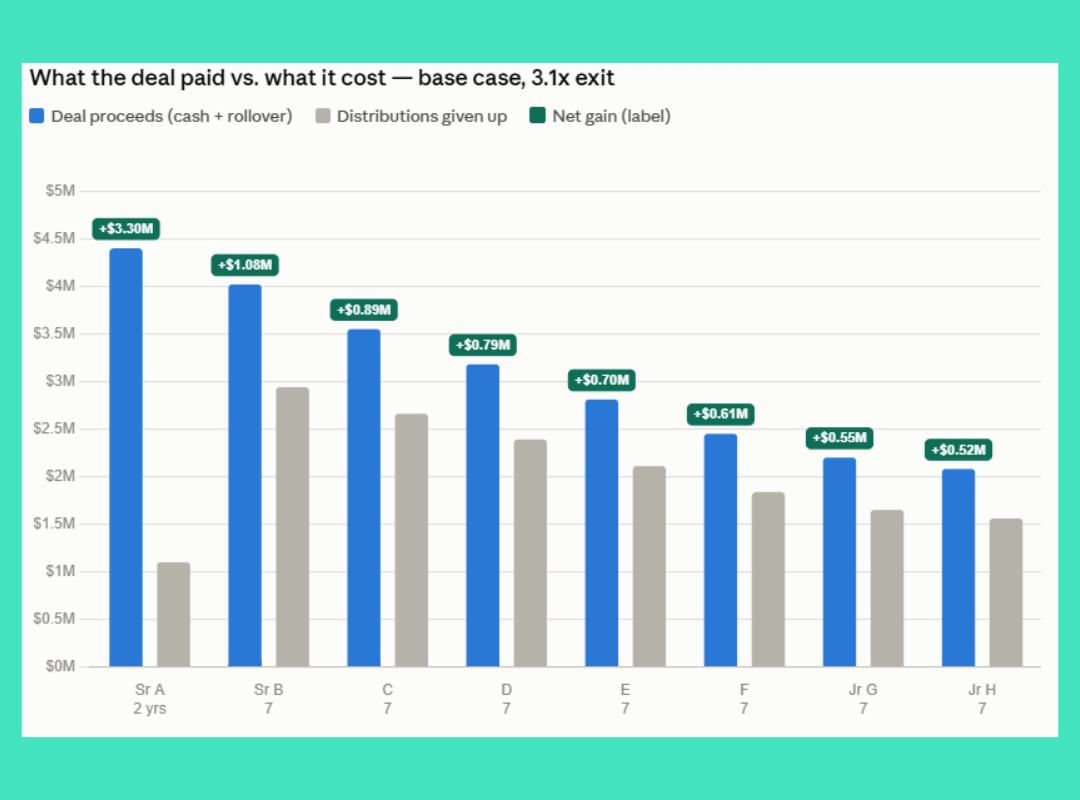
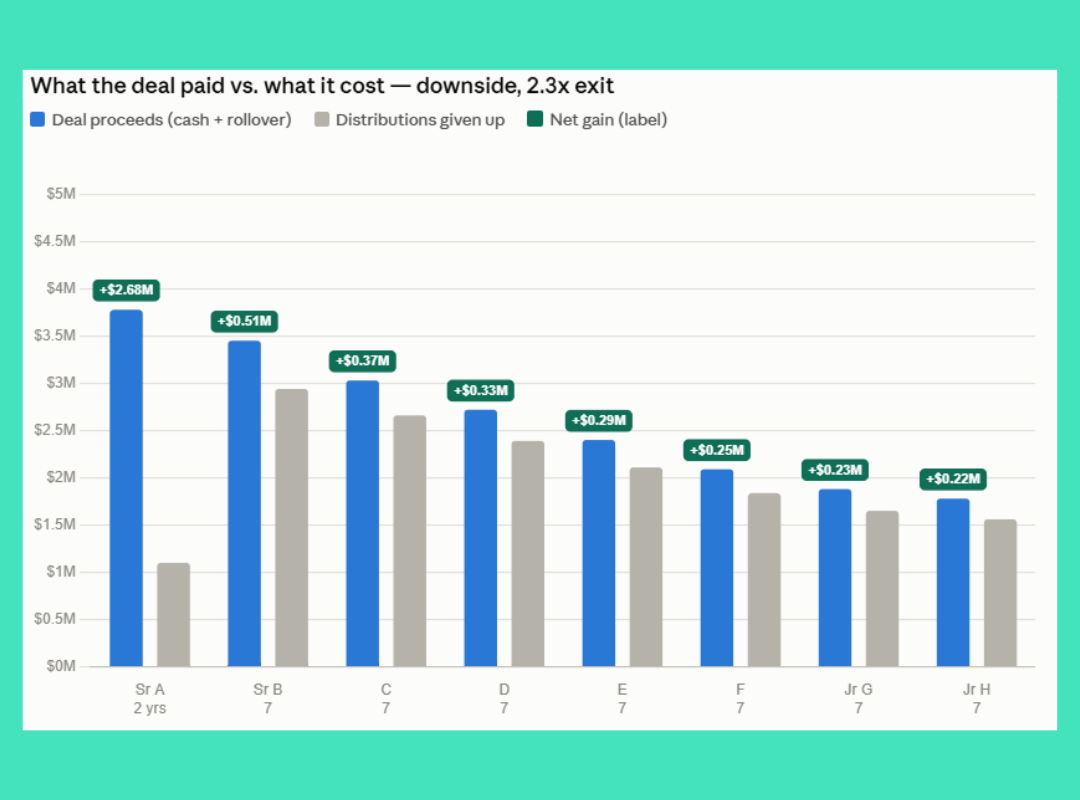
Notice how differently the downside lands. The senior gives up about a fifth of his advantage and is still comfortably ahead. The junior loses more than half of his and ends up barely above water. The major difference here is the senior retiring doc sold 2 years of distributions and took a bigger share of her money in cash and had almost no distributions left to give up, so the bet was a smaller part of her deal. For the junior it was most of the deal and the bet only gave him a slight edge.
That is just this one example, which was chosen for this fact. In these scenarios, like so many, the devil is in the details. It’s also in modeling the scenarios.
And of course there are tons of other factors at play. You can clear some debt, take chips off the table, have personal reasons for a sale. Knowing the mechanics is the key. And all in all this deal went ok. And for some of the partners it made a lot of sense.
If you have been here before, you know there are a lot of times when this goes terribly wrong.
But, your mimosa is empty. Go get a refill and tune back in to the next issue… Part 3: when the deal breaks.
Paging Dr. de la Torre…
See you out there!
Love this case study example and that no AI was harmed in the making of the waterfall charts.
Excellent explanation of why the headline valuation is only the beginning.
The same principle applies to startup founders deciding between venture capital, private equity, or remaining independent. Every source of capital is really an exchange of future control, future economics, and future optionality. Understanding those tradeoffs is incredibly important.
Really enjoying this series, thanks.