

What we’re breaking down: What happens when the deal mechanics themselves cause pandemonium
Why it matters: Knowing how things go wrong can help you make sure they go right
Read time: The time it takes to calculate whether a buying the extra-large box of cereal is actually worth it or you should just buy two smaller boxes (6 minutes for real though)
Welcome back to our series on all things private equity in healthcare. Well, not ALL things, mostly private practice things, but you know, it applies.
Because you are a rabid fan, you have already read the first two issues in the series and have been counting down the days until this issue dropped, so no recap needed. And for those of you who are set on breaking my poor southern heart, here is a roadmap to where we have been if you want to catch up:
Part 1: The Sponsor-to-Sponsor machine
Part 2: The anatomy of a deal
Part 3: When the mechanics fail and the machine breaks (this is happening right now, literally, you are in it)
Part 4: When it all comes together and the machine makes an everlasting gobstopper
Let’s get to it.
Ok, wait sorry, not quite. I do want to say, if you have been here before you may be expecting and perhaps even looking forward to reading my less than rosy shall we say, stance on private equity. I am happy to circle back, talk offline, parking lot this, and reconnect if you want to hear my personal feelings.
But know that this issue is by no means meant to be an attack, merely an elucidation of what can and does go wrong after the Pennyloafer rolls into town.
Now, let’s get to it. Again. For the first time.
Harken back if you will to the practice, Dr. Kneesandhips Emporium Limited, which was acquired by Sire Kinsington Sweatervestman MXLI. Well, now the rubber has met the road, the practice is living life post acquisition and the numbers aren’t quite behaving in the way they assumed they would.
And this is a common occurrence, a practice is bought as part of the inklings of a roll-up and all of a sudden doctors are making less and the practice that was once profitable now seems to be losing money. Or at least, making much less of it. How?
Well, as you may know, private equity companies are not allowed to own medical practices directly in most states. But how then can they buy all of these intrepid clinics you ask? So glad you asked.
They use the fabled MSO-PC model. It is a contractual arrangement between the two entities that binds them together and connects their fates. It’s all very King Arthurian. And I have written about the arrangement here if you are interested. I know, I need a hobby.
Under this arrangement, the MSO needs to create value for itself. It does that by providing services to the PC and in turn charging a premium on those services, otherwise known as a management fee. There are several approaches, but in our illustration we are going to assume a cost plus model. That is to say every service provided by the MSO to the PC is billed to the PC with a 20% kicker.
It’s important to note the incentive misalignment here. Because MSO costs are PC costs and the revenue is on the 20% kicker, the MSO makes more money when costs rise. This is about as divergent as that movie that wasn’t as good as the Hunger Games. Costs drain the practice while the MSO is enriched.
In addition to that new and exciting line item, the practice now has interest on debt that it wasn’t carrying before. It has also lost its preferential rent rate on the buildings it once owned but are now being leased back to it at fair market value (plus a little sweetener for new penny loafers). Not to mention the system conversion which stretched receivables and knocked collections down a few points. We also can’t forget the new executive team that is being allocated to the practice squad.
And since no one is used to reading entire paragraphs anymore, I had my French associate make a chart:
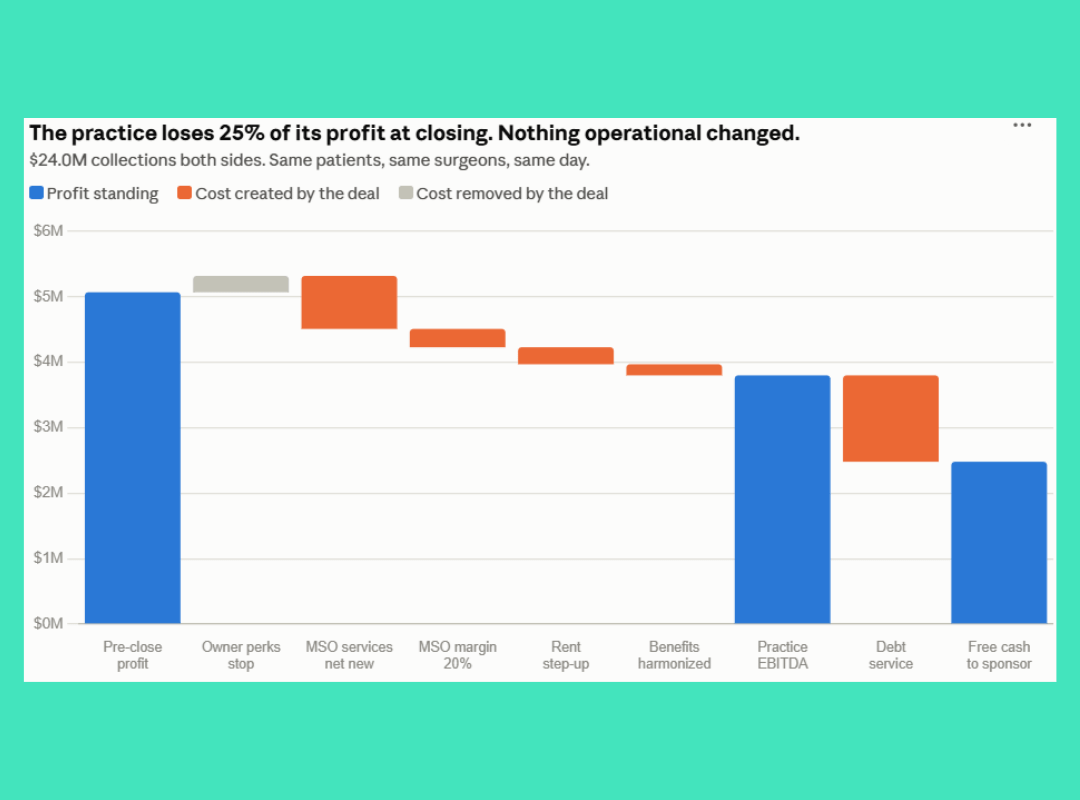
So you can see, nothing has changed operationally (yet… dun dun dunnnnnnn) but the practice now has significantly more expenses to carry, dropping EBITDA and jovial 25%.
And for the physician partners, their slice just got resliced.
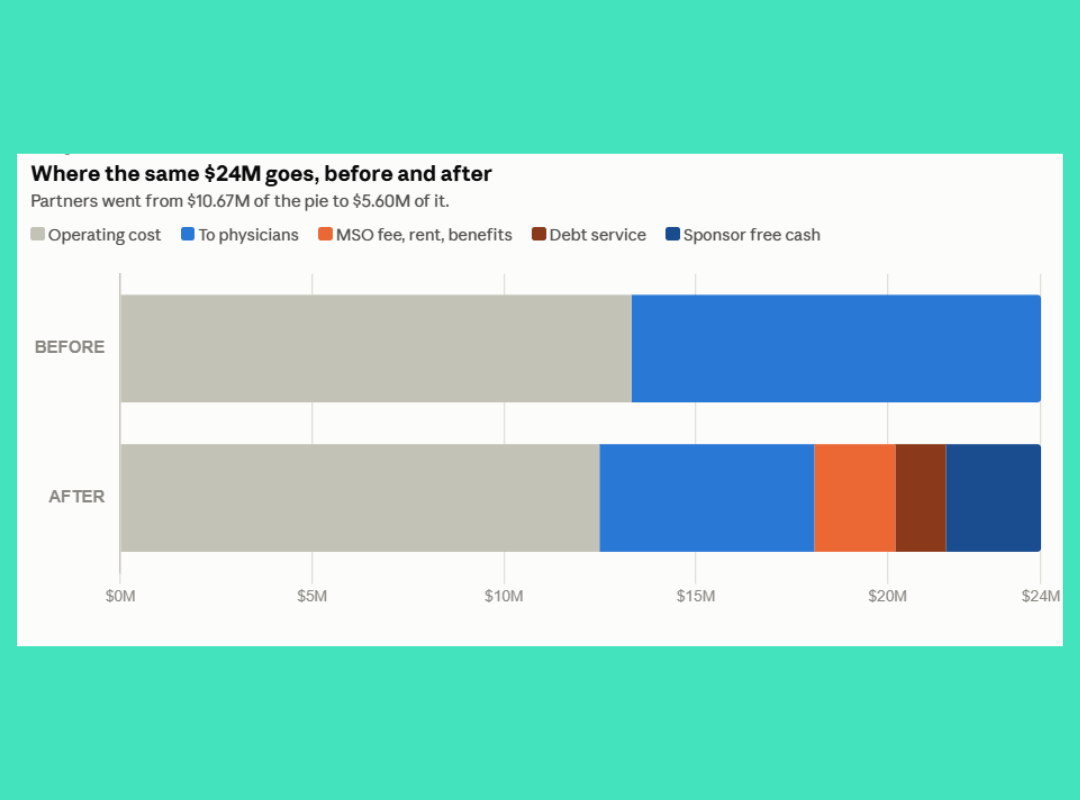
Here’s the issue. The rub. The juice. These were all terms in the contract. Maestro Goldenkeyfob knew all of this. And sometimes, these things are even discussed with the partners prior to closing. But the misalignment remains.
It can be multifactorial as to why this happens. Some combination of not fully understanding the terms, not modeling scenarios, or focusing on the eventual payoff thereby glossing over some of these realities. Whatever the reason, it often leads to the beginning of strife and tension between the practice and its new overlo… I mean partners.
No matter though, right? Sure, things may not be great and after any deal there are always growing pains. The real upside in all of this is that juicy second bite of the apple. Why they can’t just get a fresh apple with all that money, I will never know. Nonetheless! The second bite makes all of this worth it… right?
Right?
Cliffhanger… If you didn’t have a chance to fill out the reader survey from Thursday, it’s not too late, the internet never forgets or loses anything.
You may remember this episode is about things breaking, so no. No it probably won’t. The first reason is grounded in current market realities. Remember when I said I needed a hobby. Well, a month or so back I wrote about where all the money was in healthcare and described the issues facing private equity including sitting on a ton of dry-powder having not returned sufficient capital to partners and now having trouble raising funds.
I know. Hard life.
Here’s a chart of the deal count just in case things were getting a little too wordy:
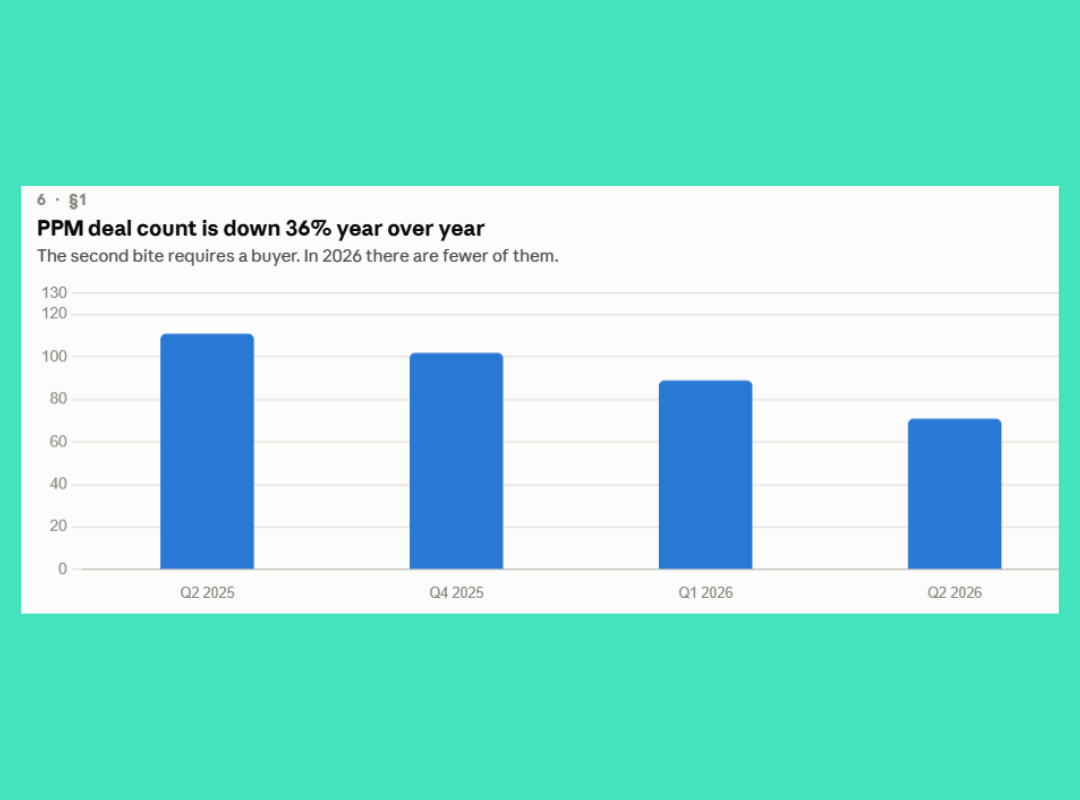
The issue is that the market is lopsided and time is running out. You would think it’s a seller’s market with so much sitting on the books yet to be deployed. The firms however, are out of time. That means they are looking for mega deals. Same plays we are seeing in VC over the last year. Still significant funding, but primarily comprised of only 12 mega deals.
Ortho rollups, any practice roll ups aren’t big enough at the moment. Not to mention over the last 5 years, many of the deals have seen distressed assets evolve as a result. Let’s just say it turns out that healthcare is hard and cost cutting profit maximization is a play book best suited for insurance carriers, not care delivery.
Who knew?
Let’s say that Dr. Hips and Charles Bromwell Wollsworth III do find a buyer for the new entity, which now boasts a much greater EBITDA, geographic prominence, and really great snacks at all office locations, including warm cookies. Here’s the eventual reality check of a soft market, high interest rates, and sponsors looking for larger deals:
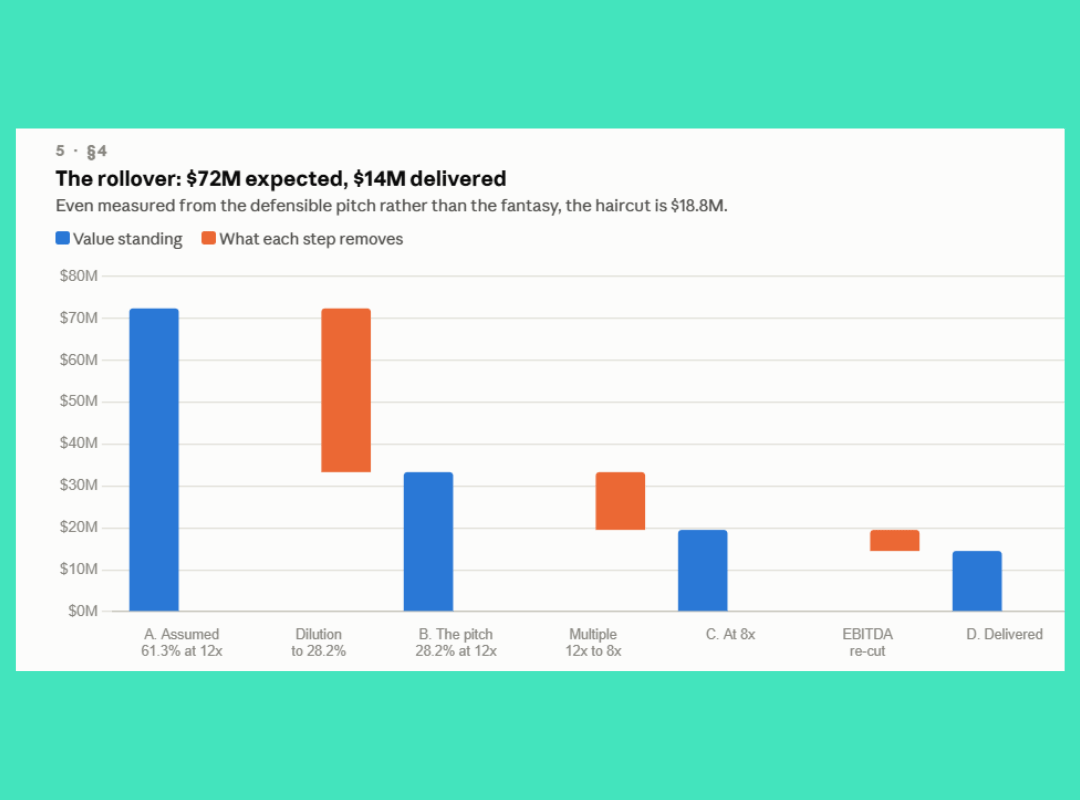
Listen, are we going to get upset about making another cool $14M? I mean yes, maybe. When the expectation was $72M and it is about to get cut 8 ways, the physicians gave up roughly $4.8M in distributions over the 7 year holding time, which if invested may have yielded a greater return. Not to mention the payout of $1.8M each is simply $3M less than they would have earned in distributions.
I am not saying it’s all about the money, and I am not saying that this is a Steward Health Care (I cant believe they spell it that way) situation, but it does crack the foundation. Even without gratuitous mismanagement, this just isn’t a very good deal.
Broken? Not entirely. But it has started to break the machine. These occurrences added up across time, not to mention the horror stories, and the plain economic realities that these deals may just not be great, are leading to less PE deals.
Whether you believe that to be a good thing or a bad thing, it is a thing.
Now, I really need some ice cream. And a mimosa.
Obviously.
See you out there!
P.S. if you didn’t have a chance to fill out the reader survey, doing so with mimosa after reading tales of private equity is the best way to spend 72 more seconds on a Sunday.
My wife and I just joined an alternative to all this mess called CrowdHealth.
It was a scary decision to become uninsured, but here’s a post about how we came to that decision!
https://nicholaswestfall.substack.com/p/why-i-got-rid-of-health-insurance?r=61w2ip&utm_campaign=post-expanded-share&utm_medium=web
Really strong breakdown. The part that stands out is that the “break” often starts before anything operationally goes wrong. The deal can be working exactly as documented, yet the economic reality for the clinicians has already changed: management fees, debt service, rent resets, executive overhead, integration drag and softer exit assumptions all start eating into the story they thought they bought.
The most important line for me is the misalignment around the MSO cost-plus model. If the MSO can make more as costs rise while the practice feels the pain of those costs, then the post-close operating model needs much more scrutiny than the headline valuation multiple.
Second bite optimism only works when the first bite does not quietly destroy trust, motivation and distributable economics. This is a great reminder that physicians need scenario modelling, not just a transaction narrative.